
Over 30 years of disappointing emissions data combined with inadequate climate policies, together paint a stark picture of Cyprus’ past, present, and future climate ambitions.

Climate Change Research: A (Brief) Timeline
Climate change has been a major public concern since at least the 1980’s. Scientists, however, have known about it a lot longer—while comprehensive scientific research didn’t pick up steam until the 1970s, the history of climate change theory can be traced all the way back to the 1800’s.
What’s more, according to the United Nations, over 75% of greenhouse gas (“GHG”) emissions can be attributed to the burning of fossil fuels—making them the largest contributor to the climate crisis. Research regarding the role of fossil fuels in rising CO2 levels dates back to the 1950s, while today, at least 98% of climate scientists (if not more) agree on human-induced climate change.
With such extensive scientific research on global warming and its causes spanning 70+ years, surely the Cyprus government has made huge strides in reducing its emissions over the years? Let’s take a look.
Cyprus GHG Emissions: 1990 v. 2022
Data obtained from Eurostat tracks Cyprus’ (and other EU countries) annual emissions per capita, dating back to the year 1990.
According to this data, Cyprus has barely made a dent in emissions reduction in over 30 years. As of 1990, Cyprus’ emissions stood at 10.6 tonnes per capita—by 2022, they had only dropped to 10.2 tonnes per capita (figure 1).
A wider look at Cyprus’ GHG emissions across the 30+ years (figure 2), shows that emissions actually rose from 1990 until the mid-2000s, peaking in 2007 at 13.7 tonnes per capita. They then declined sharply, only to rise again from 2013. The lowest point appears around 2020, likely influenced by the pandemic.
The average over the 33 year period was 11.8 tonnes per capita.
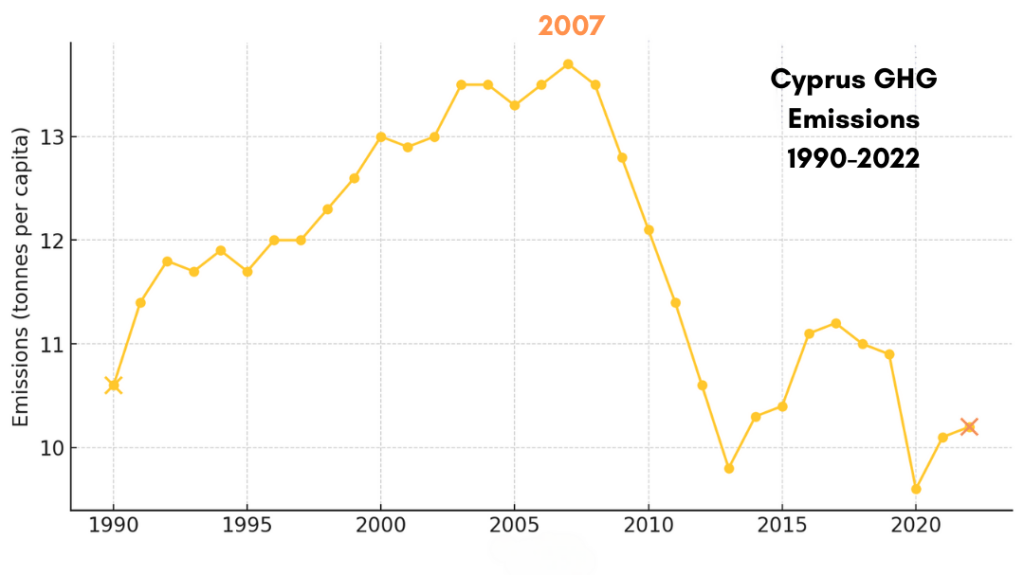
*Greenhouse gases include CO2, N2O in CO2 equivalent, CH4 in CO2 equivalent, HFC in CO2 equivalent, PFC in CO2 equivalent, SF6 in CO2 equivalent, NF3 in CO2 equivalent. Source sectors for greenhouse gas emissions: total (excluding memo items, including international aviation).
Going Forward: Inadequate Climate Policies
Notably, the Climate Change Performance Index (“CCPI”), an independent tool comparing the climate performance of 63 countries and the EU, criticises Cyprus for policies and measures which are currently “insufficient” for achieving its binding EU annual GHG emissions target. The target in question is 32% reduction by 2030 compared with 2005, for the period 2021–2030.
Per the CCPI, Cyprus’ long-term climate strategy “lacks vision”, due to its over reliance on fossil fuels and failure to consider different climate scenarios. It further notes that the introduction of fossil gas as the main decarbonisation measure for the energy sector risks creating stranded assets and carbon lock-ins, essentially impeding transition to renewables.
The 2025 CCPI report places Cyprus among the low performers, ranking it 44th (down 2 places from 2024, and down 9 places from 2023).
Below is a breakdown of Cyprus’ ratings:
- GHG Emissions and Energy Use – Medium
- Renewable Energy – Low
- Climate Policy – Very Low
Progress or Failure?
Of course, any reduction in emissions makes a difference, and we should always strive for change. However, a mere 3.8% decrease across a period of 30+ years quite frankly reeks of stagnation. In addition, when we take into account the years in which emissions actually increased, plus the lack of foresight going forward, it paints an even starker picture. What we see is a government blatantly ignoring years upon years of peer-reviewed, scientific research about a problem to which we already have all the answers.
In reality, when the goal for emissions is net zero—and it is—Cyprus’ current trajectory is just not good enough.


 Black Carbon Media