“Particularly disappointing”
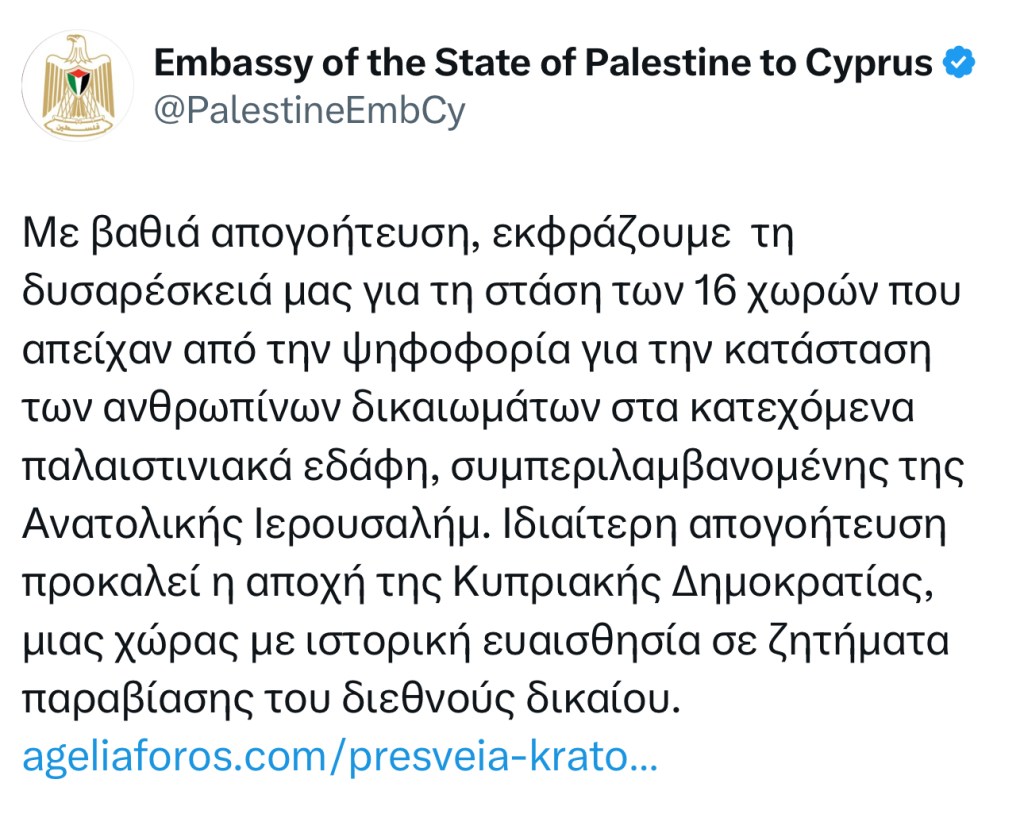
That was how the Embassy of the State of Palestine to Cyprus described Cyprus’ decision to abstain from a UN vote on human rights violations in the occupied Palestinian territories.
In a statement issued Friday (4 April 2025) on X, the embassy expressed its “deep disappointment” with the 16 countries that abstained from voting on the UN Human Rights Council (UN HRC) resolution—singling out Cyprus as a country that has itself suffered from occupation and violations of international law.
The resolution in question, titled “Human rights situation in the occupied Palestinian territory, including East Jerusalem, and the obligation to ensure accountability and justice”, was adopted during the 55th meeting of the UN HRC’s 58th session, with 27 votes in favour, 4 against, and 16 abstentions.
Arguably, Cyprus’ abstention reflects a broader trend in its deepening relationship with Israel—even in the face of mounting allegations of war crimes, ethnic cleansing, and acts of genocide against the Palestinian people. This article examines the contradiction between the Republic’s stated commitment to international law and the political choices it continues to make, raising serious questions about complicity and silence in the face of Palestinian suffering.
Explanation of vote
At the time of the vote, Cyprus (which is newly elected to the UN HRC for the period 2025-2027), defended its abstention by arguing that the resolution does not fully reflect the broader international context and risks being “politically misinterpreted” (UN Web TV, minute 58:50). The Cyprus representative further criticised the resolution for what they described as failing to clearly condemn the 7 October 2023 attacks by “Hamas terrorists”, including the hostage-taking and alleged “sexual and gender-based violence”.
In its statement, Cyprus also reaffirmed what it called Israel’s “right to self-defence within the limits of international law”, calling for renewed ceasefire negotiations to secure the release of hostages and allow the “unimpeded flow of humanitarian aid”.
The representative added, “Ultimately, the only sustainable way forward that meets the security concerns and needs of the legitimate stakeholders, is reviving the middle east peace process on the basis of a two-state solution in line with the UN resolutions.”
Cyprus voted in favour of the following additional resolutions, which were both adopted during the 59th meeting of the UN HRC 58th session:
- Right of the Palestinian people to self-determination.
- Unlawful Israeli settlements in the Occupied Palestinian Territory, including East Jerusalem, and in the occupied Syrian Golan.
War crimes, ethnic cleansing, and genocide
While Cyprus defends Israel’s right to self-defence “within the limits of international law”, and calls for the “unimpeded flow of humanitarian aid”, Israel’s actions have consistently and blatantly violated both principles. Since 2 March 2025, no aid has been allowed into Gaza, leaving millions of people without food, water, shelter, and medical supplies. Amnesty International Australia has condemned the blockade as a crime against humanity and a clear violation of international law.
Evidence of Israel’s war crimes continues to mount, leading to accusations of genocide and ethnic cleansing from UN experts (including UN Special Rapporteur Francesca Albanese), legal scholars, and major human rights organisations such as Amnesty International and Human Rights Watch.
In addition, the International Criminal Court (ICC)—of which the Republic of Cyprus is a State Party— has issued arrest warrants for Israeli prime minister Benjamin Netanyahu, former Israeli defence minister Yoav Gallant, and a former Hamas commander, citing war crimes and crimes against humanity.
More recently, Israel has been accused of covering up a war crime after footage emerged of the moment Israeli military killed 15 Palestinian paramedics and rescue workers in Rafah, including one UN employee. The video, which clearly shows the ambulances and a fire truck using their emergency signals, directly contradicts earlier claims by the Israeli military that they had fired on suspicious vehicles without emergency lights (The Guardian). They were later found buried in a mass grave with their vehicles, which had been crushed.
The killing of the 15 aid workers in March 2025 is not an isolated incident. According to OHCHR, a total of 408 aid workers have been killed in Gaza since October 2023, including 284 UNRWA staff, and 34 from the Palestine Red Crescent Society. Similarly, Reuters (citing the Palestinian Journalists Syndicate) reports that the number of journalists that have been killed during Israel’s assault on Gaza has risen to more than 210.
Over 50,000 Palestinians have been killed during Israel’s ongoing assault on Gaza—a third of them children (Reuters, citing the Palestinian health authorities).
Recent ties with Israel
Despite widespread evidence of war crimes and human rights violations, Cyprus continues to maintain political, economic, and military ties with Israel. To outline just a few of the latest examples:
Between 19 March and 3 April 2025, Cypriot armed forces participated in an Israeli-led multinational aeronautical exercise, of which the Cyprus defence ministry referred to as “military cooperation” with “friendly countries” (Cyprus Mail).
On Thursday 3 April 2025, during his visit to the US, President Nikos Christodoulides met with the leadership of the American Israel Public Affairs Committee (Aipac) with the intention of boosting “strategic” ties between Cyprus, the US, and Israel (Cyprus Mail).
On Tuesday 1 April 2025, the Cyprus government spokesman, Konstantinos Letymbiotis, stated that President Christodoulides and Prime Minister Netanyahu had a telephone conversation, in which they “reaffirmed their commitment to further enhance bilateral relations” (Cyprus Mail).
Cyprus also recently purchased from Israel its own “Iron Dome,” a Barak MX anti-aircraft defense system developed by Israeli Aerospace Industries, which according to Kathimerini, is fully operational as of the beginning of March 2025.
Questions Remaining
With overwhelming evidence implicating Israel in war crimes, crimes against humanity, and acts of genocide, how can Cyprus justify abstaining from a resolution aimed at ensuring accountability and justice for the human rights of Palestinians?
How does the Cypriot government reconcile its diplomatic language—supporting access to humanitarian aid and adherence to international law—while maintaining political, military, and economic ties with a state that stands accused of violating those very principles?
And why does the government of Cyprus, itself the victim of an illegal occupation, refuse to extend meaningful solidarity to Palestinians facing dispossession and violence?



 Black Carbon Media