
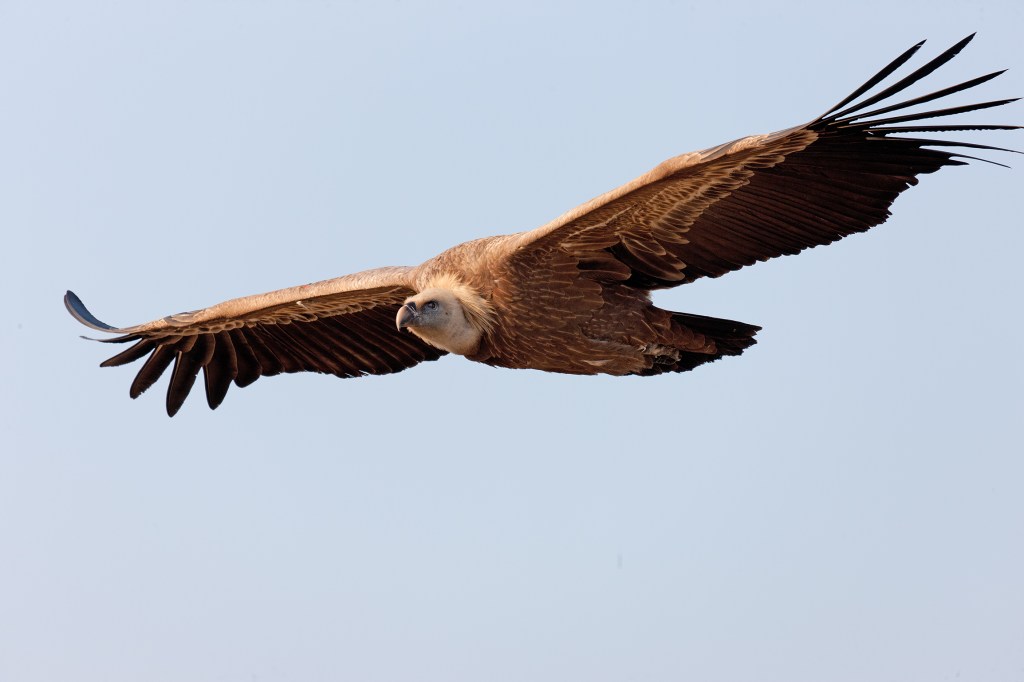
The Cyprus population of griffon vultures has been revealed to be the highest it’s been since the 1990s, when the scavenger bird’s local population faced imminent extinction.
The Cyprus Environment Foundation (CEF) revealed in their winter 2026 updates newsletter that a project they helped fund in conjunction with the EU’s LIFE programme organised by BirdLife Cyprus, the LIFE with Vultures project, to restock the island with Spanish specimens of griffon vultures reached its completion in late 2025 with the final result that the Cypriot population of griffon vultures has reached more than 40 birds, a population not seen since the 1990s.
According to BirdLife Cyprus, the population of griffon vultures in Cyprus as of 2019 was just 20 birds. In 2026, there are 41 to 44 griffon vultures in Cyprus, a two-fold increase.
About the LIFE with Vultures project
In 2019 BirdLife Cyprus teamed up with the Game and Fauna Service, Terra Cypria and the Vulture Conservation Foundation to begin the LIFE with Vultures project, funded by CEF and the EU LIFE programme.
The aim was to transport 58 griffon vultures from Spain over the course of three years, and slowly introduce them to the Cyprus wild.
How the vulture population was restocked
Over the course of three years, griffon vultures from Spain were transported over to Cyprus. They were taken to an acclimatisation aviary in rural Limassol where they were checked by a vet, tagged and stayed for six months to acclimatise to their new environment before being released into the wild.
Spanish vultures were chosen as the population of griffon vultures in Spain numbers around 30,000, meaning that transporting 58 to Cyprus over the course of three years would not impact the Spanish population, but would benefit the Cypriot vulture population greatly.
What is restocking?
In animal conservation, restocking is the introduction of a species from one area where they are native and abundant, to an area where they are native, but the population is endangered. Restocking preserves social knowledge that a local population has – such as feeding areas, breeding areas, safety areas that would otherwise be lost if the species was re-introduced following local extinction.
The practice involves transporting the population to their new habitat, letting them acclimatise safely, and then introducing them to the wild.
Why was restocking needed in Cyprus?
Cyprus’s griffon vulture had dwindled to the point where extinction in Cyprus was imminent. Previous attempts to restock the population with griffon vultures from Crete were unsuccessful due to poisonings and electrocution from unsafe electrical grid infrastructure, and as a result there hasn’t been successful breeding of the species on the island in several years.
Threats to Cyprus’s griffon vulture population
The griffon vulture was faced with imminent extinction as a result of human activities that didn’t take animal welfare into account.
The Electricity Authority of Cyprus (EAC) power lines have been a source of fatalities for the birds, and historically the griffon vulture has also suffered from poisonings from farmers controlling fox population, making the scavenger bird a casualty in human actions.
Indeed 65% of the transplanted birds have survived the restocking process, a successful number for a programme of this type, however, it still means 20 of the 58 did not survive.
Breakdown of fatalities:
- Electrocutions: 9
- Collision with overhead power lines: 2
- Poisoning: 1
- Natural factors (such as dehydration or undetermined causes): 8
With 11 griffon vultures killed by Cyprus’s electrical infrastructure, it shows how much responsibility rests on EAC’s shoulders to keep Cypriot wildlife safe, and though the electricity authority has taken steps to make its infrastructure safer for birds, it seems their actions are more reactive than proactive.
Why this news is relevant to Cyprus
What this means is that the population of griffon vultures in Cyprus is on its way to recovery and becoming self-sustaining once again. Currently the re-stocked birds are too young to begin breeding, but the expectation is that from 2026, the newly introduced birds will start having hatchlings.
This restocking introduces genetic diversity to the griffon vulture population in Cyprus, preventing genetic diseases and ensures the population can sustain itself, although the birds are under constant threat from human activity, meaning the griffon vulture’s success is reliant on Cypriot environmental responsibility.



 Black Carbon Media